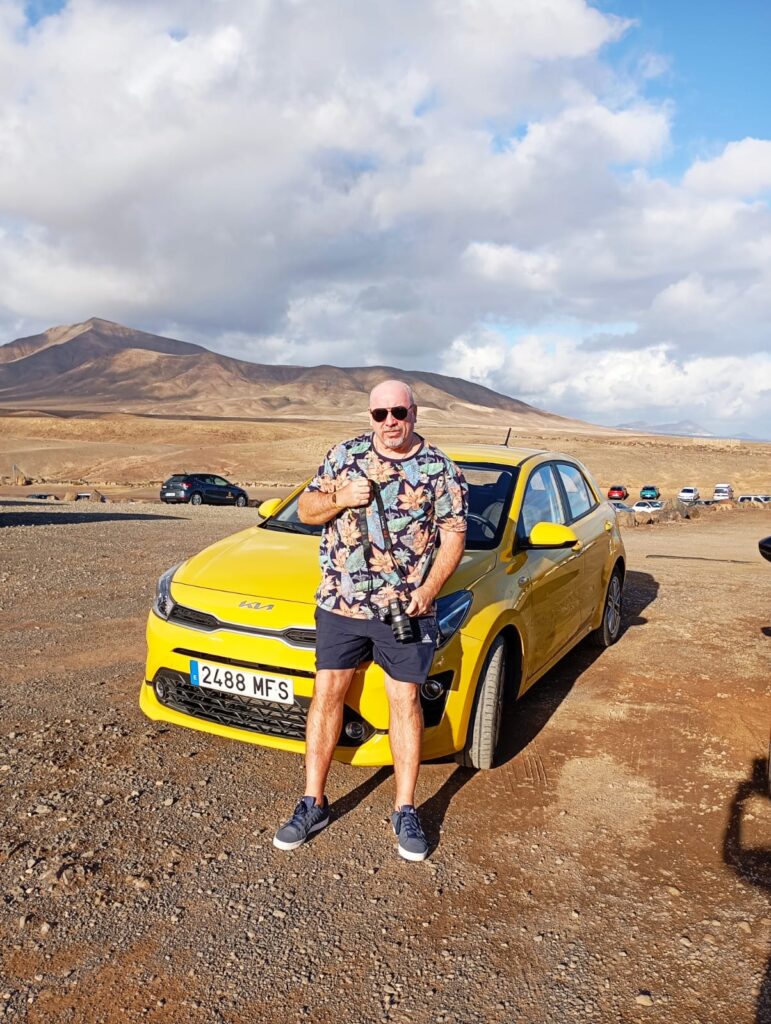
Two volcanic islands. One Atlantic Ocean. And a decision that stumps a surprising number of travellers every year. Lanzarote and Fuerteventura sit close enough together that you can cross between them by ferry in under half an hour, yet they feel remarkably different once you arrive. One is an art-infused UNESCO reserve shaped by volcanic drama and one visionary artist. The other is a wind-scraped, dune-covered paradise built almost entirely around beaches and watersports.
Neither is better. But one is almost certainly better for you — and that is the question this article sets out to answer.
Lanzarote vs Fuerteventura
Check Prices & Availability of Lanzarote Hotels
Table of Contents
A Quick Side-by-Side Overview
Before diving into the details, here is an honest at-a-glance comparison:
| Lanzarote | Fuerteventura | |
|---|---|---|
| Landscape | Dramatic volcanic lava fields | Sandy plains, dunes, coastal flats |
| Beaches | Fewer but varied; some world-class coves | More beaches, longer stretches of sand |
| Watersports | Good windsurfing, diving, surfing | Exceptional windsurfing, kitesurfing |
| Culture & Art | Strong — César Manrique legacy | Limited |
| Food & Wine | Interesting local wine region (La Geria) | Less distinctive food scene |
| Nightlife | Moderate — Puerto del Carmen leads | Quiet overall |
| Crowds | Busy in peak season but manageable | Can feel quieter in the south |
| Size | Compact — easy to explore in a week | Larger — harder to cover fully |
| UNESCO status | Yes — entire island | No |
| Best for | Culture, scenery, varied holidays | Beaches, watersports, relaxation |
Landscape and Scenery
This is where the two islands diverge most dramatically, and it is the comparison that matters most if scenery motivates your travel.
Lanzarote is defined by its volcanic past. The eruptions of the 1730s buried a quarter of the island under lava, and Timanfaya National Park preserves that eerie, otherworldly terrain in stunning condition. Black lava fields, rust-coloured craters and ochre hills stretch to the horizon, and the geothermal heat beneath the surface is close enough to the ground that you can feel it through your shoes. The entire island has been protected as a UNESCO Biosphere Reserve since 1993, and strict planning rules — inspired by the artist and architect César Manrique — mean there are no high-rise hotels, no cluttered billboards and a genuine sense of care for the environment.
Fuerteventura’s scenery is subtler but still striking in its own way. The island is older and more eroded than Lanzarote, which means the dramatic volcanic forms have worn away into rolling sandy plains and long, pale coastlines. The Corralejo Dunes in the north are spectacular — a vast expanse of white sand that shifts and reshapes with the wind. The interior of the island is sparse and semi-arid, with the Betancuria massif offering some rugged highland scenery. It is beautiful in a bleached, minimalist way, but it does not deliver the theatrical volcanic drama of Lanzarote.
Verdict: If landscape is your priority, Lanzarote wins comfortably. If you prefer open, expansive scenery without volcanic intensity, Fuerteventura has its own quiet appeal.
Beaches
Fuerteventura is widely considered to have some of the best beaches in the Canary Islands, and arguably in Europe. The sheer number, scale and consistency of its sandy shores is hard to argue with. Corralejo in the north has long, wind-swept beaches backed by dunes. Sotavento, on the east coast, is a vast stretch of pale sand that becomes a natural lagoon at low tide — famous as a windsurfing and kitesurfing venue. The Jandía peninsula in the south has calm, clear water and fine white sand that rivals anything in the Mediterranean.
Lanzarote has fewer beaches, but several of them are exceptional. The Papagayo coves near Playa Blanca are among the most beautiful in the entire Canary Islands — sheltered, golden and clear, backed by volcanic cliffs. Famara on the northwest coast is wild, dramatic and backed by towering cliffs, making it more of a landscape experience than a sunbathing destination. Playa Grande in Puerto del Carmen is wide, well-managed and convenient.
Verdict: Fuerteventura takes this category. The volume and quality of its sandy beaches is simply unmatched. But if you want intimate, sheltered coves rather than long open stretches, Lanzarote’s Papagayo beaches more than hold their own.
Activities and Outdoor Experiences
Both islands offer a strong range of outdoor activities, but they specialise in different things.
Fuerteventura is one of the best places in the world for windsurfing and kitesurfing. The consistent trade winds that funnel across the island create near-perfect conditions year-round, and Sotavento hosts international windsurfing competitions. Surfing is also excellent, particularly on the west coast around El Cotillo. Cycling is popular on the flat terrain, and snorkelling is rewarding in the calmer southern bays.
Lanzarote punches above its weight for activity variety. Timanfaya offers a unique volcano experience unlike anything in Fuerteventura. Hiking routes, including the popular Caldera Blanca trail and the coastal path from Playa Blanca to Papagayo, cover genuinely dramatic terrain. Diving is excellent, with the Museo Atlántico — an underwater sculpture park — offering something completely unique to Lanzarote. Windsurfing and kitesurfing are also available at Costa Teguise, though conditions are not quite as powerful as Fuerteventura.
A day trip between the islands is straightforward: ferries run from Playa Blanca (Lanzarote) to Corralejo (Fuerteventura) in around 25 minutes, making it easy to sample both during a single holiday.
Verdict: For dedicated watersports, Fuerteventura is the stronger choice. For activity variety — hiking, diving, volcano experiences — Lanzarote offers more depth.
Food, Wine and Culture
Lanzarote has a significant advantage here. Its food culture is rooted in Canarian tradition — papas arrugadas with mojo sauces, fresh local fish, excellent goat’s cheese — and it has a genuinely distinctive wine region in La Geria, where vines grow in individual volcanic ash pits and produce a crisp, aromatic Malvasía white wine that you can taste at bodegas across the area. Village restaurants in Yaiza, Haría, El Golfo and Arrieta offer good, affordable food with real local character.
Culturally, Lanzarote stands apart. The legacy of César Manrique — artist, architect and environmentalist — permeates the island. His converted volcanic home at the Fundación César Manrique, the transformed cave complex of Jameos del Agua, the Jardín de Cactus and the cliff-top Mirador del Río are all experiences that have no equivalent on Fuerteventura. These are not just tourist attractions; they represent a coherent artistic philosophy applied to an entire island.
Fuerteventura has less to offer in both categories. The food is decent but not distinctive, and cultural landmarks are limited. Betancuria, the old colonial capital, is picturesque and worth a visit, and the island’s Guanche (indigenous) heritage is present in a modest museum. But the cultural depth simply does not compare.
For a broader picture of how culture and landscape combine on Lanzarote, our Lanzarote travel guide covers everything from César Manrique’s landmarks to wine tasting, village markets and Canarian cuisine in full detail.
Verdict: Lanzarote is the clear winner for food, wine and cultural experiences.
Resorts and Accommodation
Lanzarote’s main resorts are Puerto del Carmen (lively, central, best range of hotels), Playa Blanca (quiet, family-friendly, close to Papagayo) and Costa Teguise (breezy, watersports-oriented). The island’s building regulations mean no resort feels overwhelming — there are no high-rise hotel towers dominating the skyline.
Fuerteventura’s main resort areas are Corralejo in the north (young, buzzy, good for watersports), Caleta de Fuste on the east coast (calm, family-friendly, sheltered beach), and Morro Jable on the Jandía peninsula (quieter, more remote, excellent beaches). The island also has some large all-inclusive resort complexes that cater to package holidaymakers seeking sun and sand with minimal fuss.
Accommodation standards on both islands are broadly similar at equivalent price points. Fuerteventura can feel slightly cheaper for large all-inclusive packages, while Lanzarote’s wider range of villas and rural casas gives more flexibility for independent travellers.
Verdict: Roughly even, with Lanzarote offering more character and Fuerteventura better value for straightforward beach package holidays.
Which Island Suits You Best?
Choose Lanzarote if you:
- Want more than just beach time — scenery, culture and activities matter to you
- Are travelling as a couple or with older children who enjoy exploring
- Are interested in food, local wine and Canarian culture
- Want a compact island that is easy to navigate in a week
- Value environmental credentials and a landscape that feels protected
Choose Fuerteventura if you:
- Want long, wide beaches and are happy to spend most of your time on them
- Are a keen windsurfer or kitesurfer — or want to learn
- Prefer a more relaxed, low-key pace with minimal sightseeing
- Are travelling with young children who need gentle, shallow water
- Want a larger island to explore over ten days or more
Consider both if you:
- Have ten days or more and can take the ferry between islands
- Want to combine Lanzarote’s culture and scenery with Fuerteventura’s best beaches
- Are a repeat visitor to one island and ready to explore its neighbour
Getting Between the Islands
The Corralejo–Playa Blanca ferry is one of the most convenient inter-island connections in the Canaries. The crossing takes around 25 minutes and runs multiple times a day. Two main operators serve the route: Naviera Armas and Fred Olsen. Booking in advance is sensible in peak season. According to Spain’s official tourism portal, the Canary Islands are one of Spain’s most visited tourist regions, and inter-island travel has become increasingly popular as visitors look to maximise their time across multiple destinations in a single trip.
Hiring a car on both islands is strongly recommended if you want to explore beyond the main resort areas. Roads are well-maintained, distances are manageable and driving is the most flexible way to reach beaches, villages and viewpoints that public transport simply does not serve well.
FAQ: Lanzarote vs Fuerteventura
Which island has better weather?
Both islands enjoy an excellent climate year-round, with average temperatures ranging from around 18°C in winter to 27°C in summer. Fuerteventura is windier — which is great for watersports but can make beach days feel blustery at certain times of year, particularly in spring. Lanzarote is slightly more sheltered in some areas. Neither island gets significant rainfall, and both are genuinely good destinations in any month. If you are sensitive to wind, Lanzarote’s sheltered southern coves and resorts may be more comfortable.
Which island is better for families with young children?
Both islands work well for families, but in slightly different ways. Fuerteventura’s calm, shallow beaches at Caleta de Fuste and the Jandía peninsula are ideal for very young children who need safe, gentle water. Lanzarote’s Playa Blanca and Puerto del Carmen are also family-friendly, and the added bonus of Timanfaya National Park, the Jameos del Agua caves and César Manrique’s attractions gives older children more to engage with. If your children are under five and the holiday is beach-focused, Fuerteventura edges it. For mixed-age families with older children, Lanzarote offers more variety.
Is Lanzarote more expensive than Fuerteventura?
The difference is not dramatic, but Fuerteventura tends to offer slightly lower prices for large all-inclusive hotel packages, particularly in the resort areas of Caleta de Fuste and Jandía. Lanzarote has a broader range of accommodation types, including boutique hotels, rural guesthouses and private villa rentals, which can push costs up at the top end but also provide excellent value at the mid-range. Day-to-day costs — eating out, transport, activities — are broadly similar across both islands.
Can you visit both islands in one holiday?
Absolutely, and many travellers do exactly this. With the Playa Blanca to Corralejo ferry taking just 25 minutes, it is perfectly feasible to spend the bulk of your holiday on one island and take a day trip or two to the other. Alternatively, if you have ten days or more, consider splitting your time — perhaps five or six nights on Lanzarote and four or five on Fuerteventura, hiring a car on each. This combination gives you the best of both worlds: Lanzarote’s culture and volcanic scenery alongside Fuerteventura’s finest beaches and watersports.
Which island is better for watersports?
Fuerteventura wins this category convincingly. The consistent trade winds make it one of the premier windsurfing and kitesurfing destinations in the world, and Sotavento in particular is legendary among both sports’ communities. Surfing is also excellent at El Cotillo and other west coast breaks. Lanzarote is not without its watersports credentials — Costa Teguise offers good windsurfing, and diving is particularly strong, especially at the Museo Atlántico underwater sculpture park — but if watersports are your primary reason for travelling, Fuerteventura is the natural choice.
Which island is better for a first-time visit to the Canary Islands?
This depends entirely on what you want from a holiday. If you want to understand what makes the Canary Islands culturally and geologically distinctive, Lanzarote is the more rewarding first visit. The UNESCO Biosphere Reserve status, the César Manrique legacy, the volcanic landscapes and the local wine culture all add up to an experience that goes well beyond the typical sun-and-sand package. If pure beach relaxation is the goal and you want the widest choice of sandy shores, Fuerteventura is an equally valid starting point. Either way, once you have visited one, you will almost certainly want to visit the other.
Conclusion
Lanzarote and Fuerteventura are neighbours in geography but quite different in character. Fuerteventura is the island you choose when beaches and watersports define your ideal holiday — it does both things at an exceptionally high level and asks little more of you than to sit back, relax and enjoy the wind and the waves. Lanzarote is the island you choose when you want a holiday that surprises you — where a volcanic national park, an artist’s legacy, a unique underwater museum and a local wine region all combine with excellent beaches to create something genuinely memorable.
The good news is that you do not have to choose one forever. A 25-minute ferry ride connects them, and the most satisfying Canary Islands holidays often involve a taste of both. Start planning your time on Lanzarote with our comprehensive Lanzarote travel guide, which covers everything from where to stay and what to eat to the best volcanic hikes and César Manrique sites — then consider adding a few days on Fuerteventura to round out an unforgettable Atlantic island escape.